

120 Years of Grace: The Madrid Home’s Living Legacy
Rosie never expected to spend 44 years at the Madrid Home. She began as a nurse’s aide, became a CNA, then a med aide, and eventually Director of Medical Records after training in Minneapolis. Asked why she stayed so long, her answer is beautifully simple: “I wouldn’t have been there for 44 years if I weren’t happy.”
In many ways, Rosie’s story is the Madrid Home’s story. People came to work, to serve, to care for neighbors and, somewhere along the way, became part of something that felt like family. That spirit has endured for 120 years, through fires and rebuilding, changing models of care and generations of residents and employees.
It began in 1906, in a rented house on 6th Street.
The Bicentennial history captured the spirit of those beginnings in a simple, powerful line: “For half a century, in adversity and prosperity, war and peace, fire and destruction, the Iowa Lutheran Home for the Aged has given Christian service to old folks unable to care for themselves.”
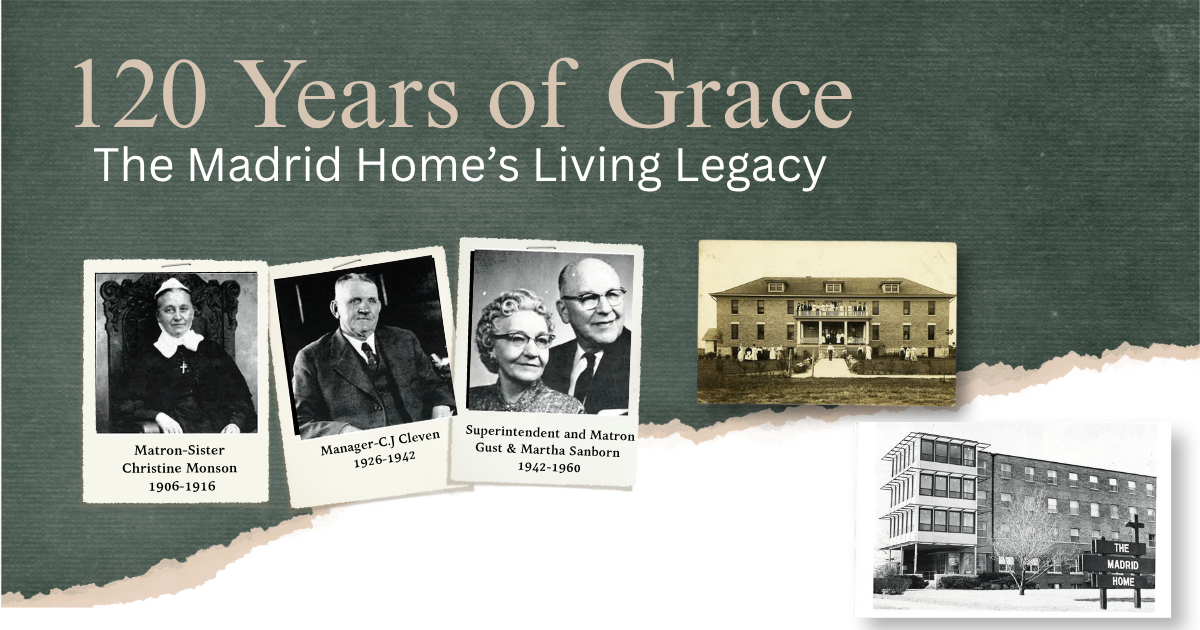
That mission took root on September 13, 1906, when Sister Christine Monson opened the first home, guided by the belief that every person deserved dignity in later life. The Madrid Home Foundation grew from a faith-based vision to care for people in the "twilight of life," at a time when elderly residents without support could easily be neglected.
Inspired by Pastor C.O. Morland, the Iowa Lutheran Conference envisioned a peaceful rural setting where Christian care could flourish. Dr. C.E. Benson and entrepreneur A.M. Sunberg were instrumental in turning that vision into reality through the first rented facility. For Sunberg, the mission was deeply personal. A survivor of the Chicago fire, he dedicated his life to the Home from its founding until his death, embodying the servant leadership that would define it for generations.
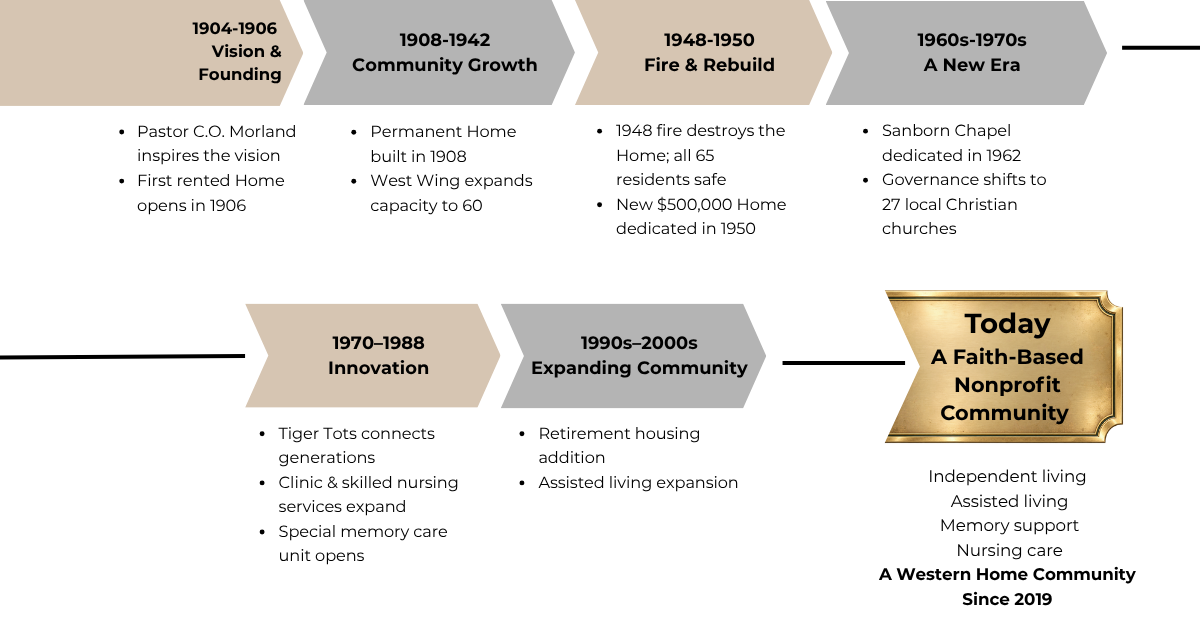
By 1908, the people of Madrid and St. John’s Lutheran Church had donated land for a permanent structure. The new two-story building, measuring 36 feet by 120 feet, was praised as “one of the most modern and well-equipped homes for the aged.” It housed 25 residents and quickly became a cornerstone of care in central Iowa.
Growth came steadily. The West Wing, added in 1916, increased capacity to 60 residents. But the Home’s reputation grew through more than buildings. Families volunteered, churches offered support and the town embraced the Home as part of its identity. From its earliest years, care was rooted in belonging, purpose and dignity.
Then, on a bitter 20°F morning on January 16, 1948, everything changed.
A fire broke out in the attic of the original building and quickly consumed the block-long structure. Historical records recount the moment with stark clarity: “The damage and loss estimates reached $200,000, yet the 65 residents remained unharmed.”
That remarkable outcome was largely due to the heroic efforts of Director of Nursing Martha Sanborn, who received a citation from Governor Robert Blue for her leadership during the crisis. Townspeople immediately opened their homes. Governor Blue arranged temporary housing at Camp Dodge, where residents would live for more than two years.
What became known as the Home’s “darkest day” could have been its ending. Instead, it became one of the clearest demonstrations of the community spirit that had sustained the Madrid Home from its beginning.
A massive fundraising effort followed. The Iowa Guild contributed $215,000, while local citizens raised nearly $35,000. Superintendent Gust Sanborn famously called the fire a “blessing in disguise,” believing it would result in a safer, more modern facility.
Construction began on November 17, 1948, and the cornerstone was laid the following summer. On April 23, 1950, nearly 2,000 people gathered for the dedication of a new $500,000 facility featuring brick and Mankato stone, pastel rooms, sunny parlors and a stainless-steel kitchen. On June 2, residents returned from Camp Dodge to a home rebuilt not only with bricks and stone, but through generosity, determination and faith.
Much of the Home’s mid-century growth took place under the leadership of Gust and Martha Sanborn, who served from 1942 to 1960. Gust, born in Sweden and trained in business administration, oversaw extensive building programs and helped shape the Home’s modern identity. Martha, a nurse and deaconess, became known for her calm strength, most notably during the 1948 fire.
Their legacy lives on in the Sanborn Chapel, dedicated on June 10, 1962. Designed for accessibility, the chapel features wide pew spacing, wheelchair-friendly aisles and stained-glass windows depicting the church’s story through the ages. It remains one of the campus’s most beloved spaces.
Following the Sanborns’ retirement, the Home continued to evolve under a succession of dedicated leaders, including Pastor Ruben Spong, Dr. J.L. Milton Nelson, Jerry McConnell and Pastor Charles Terrell. Each helped guide the organization through a changing era while carrying forward the mission established decades earlier.
Another significant transition came in 1978, when ownership shifted from the Lutheran Synod to a corporate structure comprising 27 local Christian churches. The change strengthened the Home’s identity as a local nonprofit, supported by a diverse board of doctors, farmers, ministers and other community members committed to compassionate care.
Under the leadership of Bill Thayer, the Home expanded into a full-service care community. The Sand House Clinic opened in 1979 as a modern medical clinic serving residents and the broader community. The Lillian Johnson Wing followed in 1983, providing skilled nursing and advanced medical care. Serenity West opened in 1988 as one of the region’s earliest Alzheimer’s and memory-care units. Garden Court and Grigsby Court added independent living options, allowing seniors to join the community before a health crisis changed their needs.
One of the most beloved additions was Tiger Tots Preschool and Daycare, located on-site. Residents found joy in watching and interacting with the children, bringing an intergenerational connection filled with life, laughter and purpose.
Expansion continued into the 2000s with Ballard Creek in Huxley and The Cedars in Madrid, both focused on assisted living and emotional support through life transitions. Services and buildings changed with the times, but the underlying belief remained: people deserve to age with connection, dignity and the support of community.
Buildings can tell part of the Madrid Home’s history. The people who filled them with life tell the rest.
Few illustrate that legacy better than Carol and Rosie, whose careers spanned decades of change while the heart of the Home remained remarkably constant.
Carol began her journey in September 1979, working nights for nine years before serving as Assistant Director of Nursing and twice as Director of Nursing. Her career spanned more than four decades of leadership, mentorship and hands-on care.
Carol remembers the Home not simply as a workplace, but as a living classroom: “The rule here is you’ve gotta learn something new every day.”
Her philosophy was practical and deeply personal. She taught nurses that one of the best ways to truly know a resident was to give them a shower, because moments of vulnerability could reveal trust and personality in ways an assessment form never could.
For Carol, caring for others was also an act of stewardship. “People often wonder what will make their lives significant. Jesus lived as a servant. Even little things, like being kind and listening, matter.”
If Carol represents a lifetime of leadership and mentorship, Rosie embodies the heartbeat of daily life and care.
During her 44 years at the Madrid Home, Rosie watched nearly every part of the campus evolve. She remembers residents gardening north of the Home and growing tomatoes and other produce for the kitchen. She remembers the men’s ward in the basement, the evolution of the skilled wing, the arrival of independent apartments and modernization that allowed residents to receive rehabilitation close to home.
But when Rosie talks about the Madrid Home, she returns again and again to people.
Coworkers became family. Residents’ families became part of her life. The mission was not simply something written on a wall, but something lived every day. Her motto was straightforward: “Treat those as you’d want your own parents to be treated.”
And the relationships stayed with her.
“Those residents are like your mother and father, your aunt, your uncle. You form a bond and help them live their best lives.”
Today, the Madrid Home at 613 W. North Street remains a Christian service-based nonprofit offering independent living, assisted living, memory support and nursing care. Residents experience a blend of tradition and innovation through welcoming common spaces, dedicated staff, spiritual support and a culture that honors each person’s story.
The services have changed considerably since that rented house opened on 6th Street in 1906. Buildings have risen, burned and been rebuilt. Models of care have evolved. Generations of employees and residents have passed through the Home’s doors.
Yet the stories of Carol and Rosie echo the same spirit that shaped those earliest days: faith, resilience and the unwavering belief that caring for one another is one of the greatest callings a community can embrace.
One hundred and twenty years later, that living legacy continues.