

A Roadmap Forward

When Dan Lorenz was fifty-eight years old, he said something that stopped his wife, Chris, cold: “I think I have memory problems.”
At first, Chris brushed it off. Dan was brilliant. Always thinking about the next idea. But over time, the gaps widened. A neurologist confirmed mild cognitive impairment, and just like that, the future they had imagined began to shift.
“We walked out of that appointment and I said, ‘What do we do next?’” Chris recalls. “And the doctor said, ‘Start thinking about where you want to live in a few years.’ That was it. No roadmap. No guidance.”
After the diagnosis, she found herself scanning every moment for signs of decline. Was he confused? Was he frustrated? Was she overreacting? The uncertainty was relentless.
As Dan’s needs increased, so did the weight of responsibility. Chris became scheduler, medication manager, advocate, and constant companion. Nights were lighter with sleep again. Days were heavier with decision-making. “I couldn’t be in another room,” she says. “I was always listening.”
Jan Blevins remembers when her own world began shrinking as her husband Mike’s Alzheimer’s progressed. “He was always three feet away from me,” she says. “I couldn’t shower, nap, or even sit in another room. It was a 24/7 job. I stopped volunteering. I stopped doing the things that made me, ME.”
For Eldon Brasch, the turning point came during one of the coldest weeks of the year. By then, much of his world had narrowed to the walls of his home. Sandy vacuumed the same stretch of carpet over and over, a repetitive comfort that dementia sometimes creates. Caring for his wife had become consuming. Fewer visitors. Outings were rare.
“There was a day in January,” he recalls. “Twenty below outside. The vacuum batteries were dead. We’d read every book in the house. We were just sitting there. And I thought, we are so isolated right now. I have no idea what to do next.”
But isolation wasn’t the only concern. Sandy had begun to fall. Hallucinations and fear were taking a toll. “I’d take care of Sandy as long as I could, but when she started falling, that was it.”
Different homes. Different marriages. The same slow erosion of a relentless disease. For many caregivers, love remains constant while exhaustion quietly grows. Safety becomes the tipping point. The question shifts from "Can I do this?" to "How long can I keep doing this alone?"
For Chris, Jan, and Eldon, the answer eventually led to Thalman Square at Western Home Communities. Thalman offered a way forward and an environment that breaks the stigma of dementia care. It was a place where they could begin to move from full-time caregiver back to loving spouse.
Connected to Windhaven Assisted Living on the Western Home Communities campus, Thalman Square often becomes the first step for families navigating early- to mid-stage dementia. Designed as two intimate neighborhoods connected by a bright, welcoming “square” common area, the environment feels less like a care unit and more like a small community.
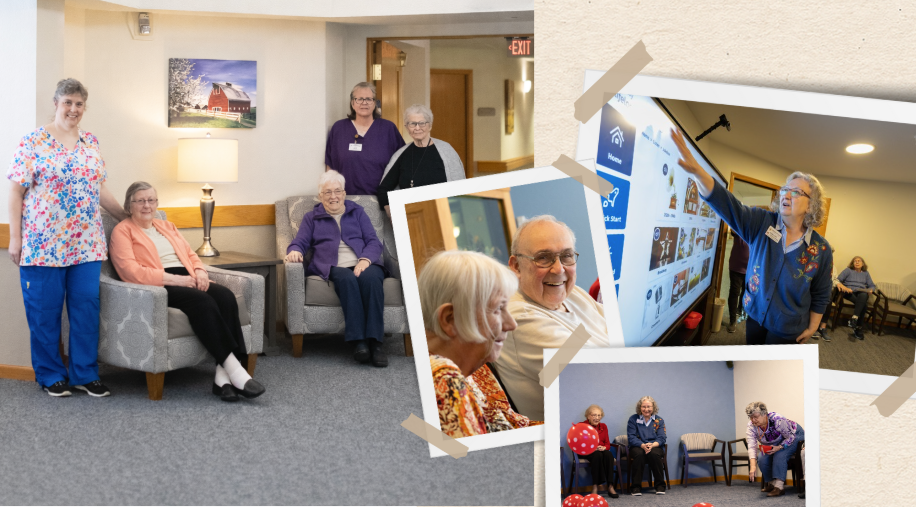
Valerie Cornish, Norma Hager, Maureen Oates, Ann Lynch, and Sharon Klages gather in the classic Thalman “Square,” where Valerie and Ann each celebrate more than 30 years of service to Western Home.
Hollie uses interactive technology to project large-print lyrics as residents enthusiastically sing Johnny Cash’s “Ring of Fire.”
Residents share laughter during a spirited game of dice, then put their aim to the test, competing to land a bean bag in the “Ring of Fire.”
For many, it becomes the space between living independently and needing more advanced care. For caregivers, two emotions are simultaneously felt: relief and heartbreak.
Inside Thalman Square, the day unfolds with a steady rhythm.
Morning light fills the square as residents gather for coffee. Some arrive independently; others are guided by a familiar hand on the shoulder. The environment is active but unhurried, structured without feeling rigid.
Thalman uses a block scheduling approach designed to keep residents engaged and connected throughout the day. Mornings might include chair yoga or music. Late mornings bring art projects or reminiscence conversations that spark storytelling. Afternoons often mean courtyard walks, gardening, interactive games, or group activities that invite laughter and movement.
“We’re not here just to supervise,” says Hollie Beem, Thalman’s leisure services coordinator. “We’re here to entertain, to engage, to help people feel alive.”
Evenings are intentionally quieter. Lights dim. Music softens. Staff lower their voices. The goal is simple: help residents end the day in peace. “Not chaos,” Hollie says.
Technology supports the daily rhythm. A large interactive touchscreen system brings residents together for trivia, sing-alongs, virtual travel experiences, and video calls with family. But technology never replaces human connection. “It amplifies it,” Hollie proclaims.
For Chris, the day Dan moved into Thalman was both devastating and freeing.
“I felt like I was deserting him,” she says. “But I couldn’t be his 24/7 caregiver anymore. I needed to be his wife again.”
The difference wasn’t immediate joy. It was steadiness.
Chris could visit without scanning every movement for danger. She could sit beside him instead of hovering. She could go home at night and sleep.
Jan remembers something similar. Shortly after Mike moved into care, a friend looked at her and said, “You look like the Jan I used to know.”
“The weight lifted immediately,” she says. “I didn’t realize how much I had been carrying.”
For Eldon, relief came more quietly. It came in knowing that Sandy was safe. In hearing conversation and music drift from the square instead of the silence of a winter afternoon. In returning to his role as husband rather than full-time protector.
“I told myself I’d take care of her as long as I could,” he says. “But there comes a moment when loving someone means letting other people help.”
At Thalman Square, that help is not a replacement for family. It is reinforcement.
Memory loss reshapes more than one life. Supporting residents also means supporting the people who love them.
Each week, Hollie Beem leads a dementia caregiver support group that meets in Windhaven’s movie theater room. The circle draws between six and fifteen participants, with nearly twenty caregivers currently connected through regular coaching and conversation.
For Eldon, the group became a lifeline. “There is nobody except the people in that room who know what you’re going through,” he says. “That’s why we keep coming back.”
The conversations range from medical updates to communication strategies. They share grief and sometimes carry the emotional weight of long goodbyes. They also laugh, sometimes unexpectedly, at the strange, human moments dementia brings.
Chris found reassurance in both the education and the honesty. “The group helped me accept that there’s no magic pill,” she says. “It also helped me find joy again.”
Jan agrees. What began as a resource became a community.
“Most of us, from the first support group, have lost our spouses now,” she says. “But we still meet. We still support each other. We’re friends for life.”
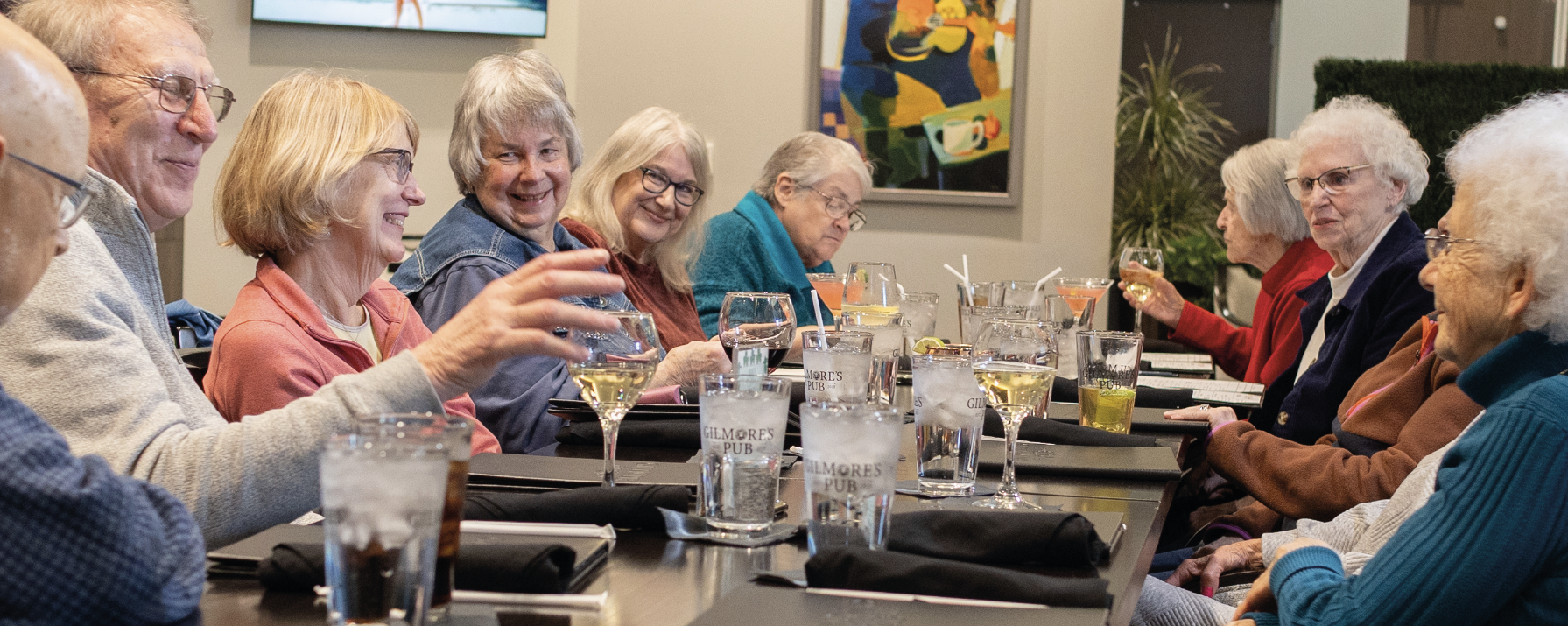
What began with a few members of the Dementia Care Support Group has grown into lasting friendships, as they gather each month at Gilmore’s Pub for encouragement, conversation, and good food.
All three now give back, volunteering with Western Home’s support group or participating in UNI’s Dementia Simulation House programs.
Hollie approaches each support group gathering with a trauma-sensitive lens, blending professional training with lived compassion. “Everyone has a journey,” she says. “Everyone experiences pain and loss. Dementia changes the process, but there can still be moments of joy, connection, and smiles.”
Thalman Square provides daily structure and safety. The support surrounding it extends far beyond its walls.
For families who have walked through diagnosis, denial, exhaustion, and the quiet grief of change, that ordinary scene carries extraordinary weight. It represents safety without sterility. Structure without confinement. Community without chaos.
Thalman Square does not promise to stop dementia. It does something quieter — and just as important. It creates space for relationships to continue. For spouses to return to being spouses. For conversations to unfold without fear.
Different families arrive with different stories. But many leave each evening with the same steady reassurance: their loved one is safe, engaged, and surrounded.
And in the morning, the square will fill again. Coffee will be poured. Conversations will begin. Another day will unfold with purpose.
