

A Future of Impact: Heather Schroeder
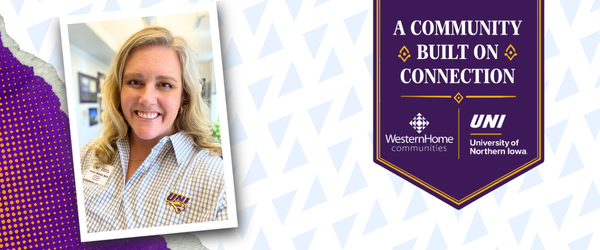
Heather Schroeder believes one of the greatest challenges facing communities today isn't a lack of resources. It's a lack of connection. As UNI's vice president for student life and a member of the Western Home Communities Board of Trustees, she spends her days helping people find places where they belong.
Her mission is profound: to help students succeed by supporting every part of their lives outside the classroom. But her passion lies in something deeper: bridging the generational divide that has quietly widened in American life.
Heather believes students often need “permission” to enter shared spaces, especially those that feel unfamiliar. She sees the same hesitation among seniors who question whether they belong on a college campus. Her work focuses on dissolving those invisible barriers. “Belonging,” she says, “is the feeling that you matter and are supposed to be in a specific environment.” Through the UNI–Western Home partnership, she is helping both communities rediscover that sense of belonging.
It is the same vision articulated by UNI President Mark Nook and Western Home Communities CEO Kris Hansen: removing barriers and creating opportunities for people of different generations to learn from one another.
A central theme of Heather’s vision is the creation of “third spaces” — environments outside home or work where people naturally gather and connect. UNI’s dining halls, consistently ranked among Iowa’s best, are open to the public and serve as one such living room. Western Home’s Gilmore’s Pub offers a parallel invitation for students to step into the daily rhythm of community life. These spaces are intentionally porous, designed to break down the “Am I allowed to be here?” barrier that keeps generations apart.
Heather views these interactions as essential to student development. Many Western Home residents are UNI alumni, former educators, or longtime Cedar Valley leaders. When students meet them, they gain not only mentorship but also a sense of continuity, a reminder that the trailblazers across from them shaped the rights, roles, and opportunities they enjoy today. Residents gain energy, curiosity and connection, filling gaps left by the distance from their own grandchildren.
This “circle of community,” as Heather calls it, is where the partnership becomes more than a collaboration. Students clear snow for neighbors. Residents attend UNI theater productions. Student organizations meet at the Diamond Center or Gilmore’s Pub. These are not formal programs; they are organic acts of belonging.
What UNI and Western Home have built is not a partnership in the traditional sense. It is a culture that grows through shared meals, stories, challenges and purpose. In this culture, a nursing student discovers her calling, a resident finds renewed hope and a CEO and a university president finish each other’s sentences because their missions are intertwined. It is a culture that reminds us that community is not something you join. It is something you create.
The UNI–Western Home relationship is not static. It evolves with the Cedar Valley’s needs. When COVID-19 exposed the region’s critical shortage of nurses, UNI responded by launching a nursing program, not to compete but to fill gaps. “They identified the gaps and built bridges,” Hansen said. Clinical sites opened, and fundraising support materialized. A regional workforce pipeline began to take shape. For Heather, it was another example of what happens when institutions stop asking whose responsibility a challenge is and start asking how they can solve it together.
That synergy now extends across healthcare, engineering, education and beyond. For Western Home, the future is about living well, intellectually, socially and spiritually. “Living well isn’t just working out,” Hansen said. “It’s learning. It’s music. It’s conversation. It’s curiosity.” Dr. Nook agrees, seeing Western Home as a vital part of UNI’s extended learning ecosystem.
Heather sees the next evolution of the partnership in intergenerational living. She imagines residence halls where seniors, students and even single parents live side by side — sharing meals, stories and everyday life. She believes these shared environments create stronger relationships and a deeper sense of community for everyone involved. She dreams of hiking groups, painting nights and rotating book clubs that flow seamlessly between campus and Western Home. Her vision is simple: create a consistent rhythm of connection that spreads throughout the Cedar Valley.
As UNI celebrates its 150th anniversary and Western Home expands its vision for community living, each leader shares a common horizon: a Cedar Valley where people of all ages feel connected, supported and enriched. “We’re building a sense of place,” Nook said. “A place where people want to live, work, learn, and retire.” Hansen echoed the sentiment: “If we’re all living well, the barriers fall away, and we create the kind of community we all want to be part of.” Jerry Harris added, “It is a shared future, built together.”
