

Preserving a Legacy, Building the Future
Western Home Communities exists because, more than a century ago, a family decided that the best way to honor what they had inherited was to put it to work for the future.
In 1911, members of the Pfeiffer and Merner families offered the Pfeiffer family farmstead in Cedar Falls, along with
$20,000, to make a long-envisioned home for aging members of the Evangelical Association a reality. The following year, the Western Old People's Home opened
on that land, marking the start of what would eventually become Western Home Communities.
They did not preserve the family farm simply for what it had been. They put it to work for what could come next.
Looking Ahead
At the center of that conversation is the former Stanard Family Assisted Living building at 420 E. 11th Street, closed
since 2022 in the wake of the COVID-19 pandemic. For generations of residents, employees and families, the building holds meaningful memories. Its chapel hosted weddings, memorial services, worship gatherings, and quiet moments of reflection. Friendships were formed there. Lives were lived there. Its halls carry stories that remain an important part of Western Home's history. Honoring that history matters. So does understanding what true stewardship requires.
For Jerry Harris, President of Cedar Falls Operations, the question has never been solely about a building. He sees a direct link between today's decisions and the founders' vision.
"The Pfeiffers and Merners were never standing still in their philanthropic work," Jerry said. "Their record shows they were always looking ahead, asking what could be done next to serve the community's greater good." That is stewardship: caring for resources thoughtfully, honoring what came before, and investing them where they can do the most good next.
As Western Home examined the property's future, leaders explored adaptive reuse options. Ultimately, the building's structural, accessibility and long-term viability challenges could not be resolved without substantial investment and ongoing responsibility.
For Pat O’Leary, Chief Strategy Officer at Western Home Communities, that decision reflects a broader commitment to stewardship. “We’re committed to adaptive reuse of our facilities wherever possible and to being good stewards of both Western Home’s resources and community resources,” Pat said. “That means preserving the physical pieces of our heritage where we can, while also making thoughtful decisions about how those properties can best serve people going forward.”
Those realities are familiar to Abbey Gilroy, developer at Coterie Real Estate, whose team specializes in redevelopment and adaptive reuse. Older structures can present aging systems and structural limitations that make preservation difficult. For Abbey, redevelopment sometimes means recognizing that preserving a place’s story may require difficult decisions about the physical structures themselves.
As Abbey describes it, successful redevelopment means “honoring tradition while embracing the new.” Kris Hansen, CEO of Western Home Communities, reached a similar conclusion during the evaluation. “The existing structure would severely limit the ability to provide adequate parking, accessibility, and long-term viability for the new neighborhood,” he explained.
Through Grove Street Partners, Western Home Communities and Coterie Real Estate are combining Western Home’s history of creating community with Coterie’s redevelopment expertise to shape what comes next.
Creating Community
The larger question became: How can this property best serve Cedar Falls for the next generation? Housing is one answer. A 2023 housing study found Cedar Falls will need about 740 additional units by 2030, while employers and workers continue to seek quality workforce housing options.
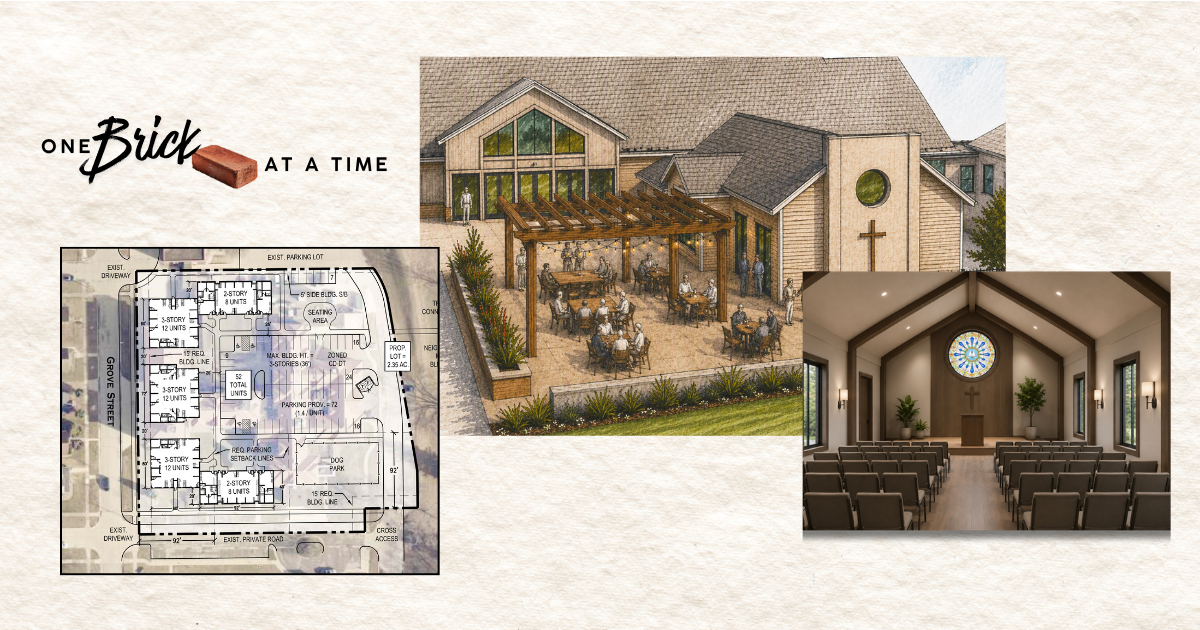
The Grove Street development will transform properties on both sides of 11th Street into workforce-attainable rental housing near downtown Cedar Falls. Together, the former Western Home Stanard and Willowood properties are expected to create approximately 90 rental homes as part of the Grove Street development, with parks, schools and recreational trails nearby.
"Receiving the state workforce housing award is a critical step because it makes this development financially feasible," Abbey said. "With that support in place, we can move forward with greater certainty and advance the work needed to bring attainable housing to Cedar Falls." For Abbey, however, housing is only part of the story. Success is measured less by buildings than by what happens around them.
“The Grove Street redevelopment is not a departure from Western Home’s history. It is a continuation of it.”
The project includes walkable connections to local trails, gathering spaces, seating areas and a dog park. "Success is really social vitality," Abbey explained. The goal is for residents to use the trails, support local businesses, gather with neighbors and bring renewed activity to a previously vacant site. Increased residential density can help sustain coffee shops, bookstores, restaurants, and other small businesses that give downtown districts their character and energy.
For Pat, the connection is a natural extension of what Western Home has been doing for generations. “Creating community is already part of our DNA,” he said. “We’ve spent generations thinking about how people live, connect and experience wellness. This is another way we can leave our footprint on the community, creating quality, sustainable housing that serves the people who live and work here.”
"Our next generation is our workforce, and investing in them is part of our responsibility as an organization," Kris said. "We want our employees and others who work in Cedar Falls to have opportunities to put down roots and become part of the community. This development creates space for that next generation and strengthens the community we all depend on."
The project also reflects another shared value between Western Home and Grove Street Partners: responsible development. Abbey emphasizes that redevelopment should happen with communities, not to them. The leadership team has worked closely with city leaders, the Historic Preservation Committee, and neighborhood stakeholders throughout the planning process because every project ultimately becomes part of someone's backyard.
That collaborative approach reflects a principle that has shaped Western Home from the beginning: buildings and land are resources for serving people, and how they are used must evolve as community needs change. The Grove Street redevelopment is not a departure from Western Home's history. It is another chapter in it.
Carrying the Legacy Forward
The Stanard family remains part of that living legacy. Dave and Judy Stanard made a significant gift in honor of Dave's parents, Clair and Verona, which led to the 2000 naming of Stanard Family Assisted Living. Today, the Stanard name continues to serve residents through Stanard Family Assisted Living at The Deery Suites on Western Home's South Campus.
The chapel's legacy will endure as well.
For Jerry, the building's significance is inseparable from the generations who gathered there. "This chapel has meant so much to generations of families. It’s a place where people spent time with their grandparents, parents, and loved ones, making memories together. It’s also where families gathered for some of life’s biggest moments—weddings, memorials, and funerals."
“It is preservation with purpose: taking a what has meaning in one chapter and giving it a place in the next.”
To honor that legacy, significant architectural elements of the chapel are being preserved and repurposed across campus. Stained glass, woodwork, stone features, and the chapel's iconic 54-inch circular window are being salvaged for future use, including incorporation into a planned new chapel on the South Campus.
The chapel is intentionally designed to reflect the scale and purpose of its predecessor and to serve residents of Thalman and Windhaven. It will provide space for worship services, hymn sings, Bible studies, quiet reflection, staff training, and community programs.
Sixteen stained-glass panes will be distributed across campus so that multiple buildings carry a piece of the chapel's story. Even the original stone "Chapel" sign is expected to find a place in the new structure. Another meaningful connection to the past endures. Like the original chapel, the new one is being made possible by philanthropy. According to Jerry, the first pledges have already been received. "The new chapel will be funded entirely through gifts, just like the original chapel was more than 100 years ago. It's a wonderful reminder of how generosity has shaped our community from the very beginning." It is preservation with purpose: taking what has meaning from one chapter and giving it a place in the next.
Throughout its more than a century of history, Western Home Communities has continually adapted. Buildings have changed. Services have expanded. New campuses and care models have emerged as community needs have evolved. Yet the underlying principle has remained remarkably consistent: use the resources entrusted to the organization to serve people well, both today and for generations to come.
More than a century ago, the Pfeiffers looked at family land and saw more than what it had been. They saw what it could make possible. Today, Western Home carries that same responsibility forward. As the Grove Street redevelopment and new chapel move ahead, they will reshape familiar parts of the campus and neighborhood while carrying history forward through preserved stories, salvaged architectural elements, the continuing Stanard legacy and renewed investment in Cedar Falls' vitality.
Preserving a legacy does not always mean preserving every brick. Sometimes it means preserving the vision that made those bricks possible.